Archives
-
Summer 2011: The 20th Century
No. 1 (2011)Welcome to the first issue of the University of Sussex Undergraduate History Journal. We aim to showcase the very best of the creative and vibrant history written by Sussex students across multidisciplinary subjects, and in doing so hope to inspire both debate and reflection. This journal gives students a chance to receive recognition for the hard work that goes into writing their essays, and we are proud to be able to release them into the academic world. In turn, the journal allows wider academia an insight into the fresh and innovative ideas blossoming from undergraduate talent.
Edited by George Bodie, Francesca Dennis, Elizabeth Hardwell, and Julia Kompe.
Contents
Matthew Blissett, Assess the effect of structures and of human agency in the making of history in reference to one of the first two thematic strands from the History of Now.
James Adams, Why was Daniel Goldhagen's book Hitler's Willing Executioners so popular in Germany?
Adam Tolcher, How does the 1922 Rand Rebellion reveal the relative importance of race and class in South Africa?
Sam Walton, Who was at fault for the Cold War?
David Hutt, Is history repeating itself in the growth of nationalism and anti-immigrant sentiment in the British National Party? -
Autumn 2011: Personality and History
No. 2 (2011)The theme of our second issue is Personality and History. There are so many ways of approaching historical analysis and the study of popular culture, examining ordinary people and the everyday, has become increasingly important in recent decades. Yet the influence of individual, extraordinary characters remains compelling and should not be neglected. All four pieces in this issue critically examine the influence of personality in a particular time and place.
Edited by Elizabeth Hardwell and Julia Kompe.
Contents
Katharine Williams, What was the Cultural Significance of Catherine of Braganza to the English Court of the 17th Century?
Jack Merron, From Liberty to Terror: Robespierre and the Justification of the Reign of Terror
Alexander Crawford, What Did Sieyes Mean By National Sovereignty?
Dominic Butler, Women, the People’s Peace and Conservative Defeat: Why did the Conservatives Lose the 1945 General Election? -
Spring 2012: Historical Memory
No. 3 (2012)The focus of our third edition lies on the subject of historical memory. Of great importance for the field of cultural history, historical memory, whether experienced by an individual or a collective, allows us to see historical events from various perspectives. Whilst affording us illuminating insights into representations of the past, the role of memory in individual reconciliation and composure allows us to connect with the methodological problems of historical study and its inherent subjectivity. We hope that this issue demonstrates that this subjectivity can be celebrated, and that the articles we chose will complement the existing scholarship in their fields by shedding fresh light on aspects of historical memory.
Edited by Elizabeth Hardwell and Julia Kompe.
Contents
Charlotte Fraser, The Train in the Holocaust from the Perspective of the Victims
Danielle Joyce, Discuss the Role of Memory in Understanding the Situation in Northern Ireland
Ruth Taylor, Assessing the Relevance of Ethnic Cleansing in the Field of Genocide Studies -
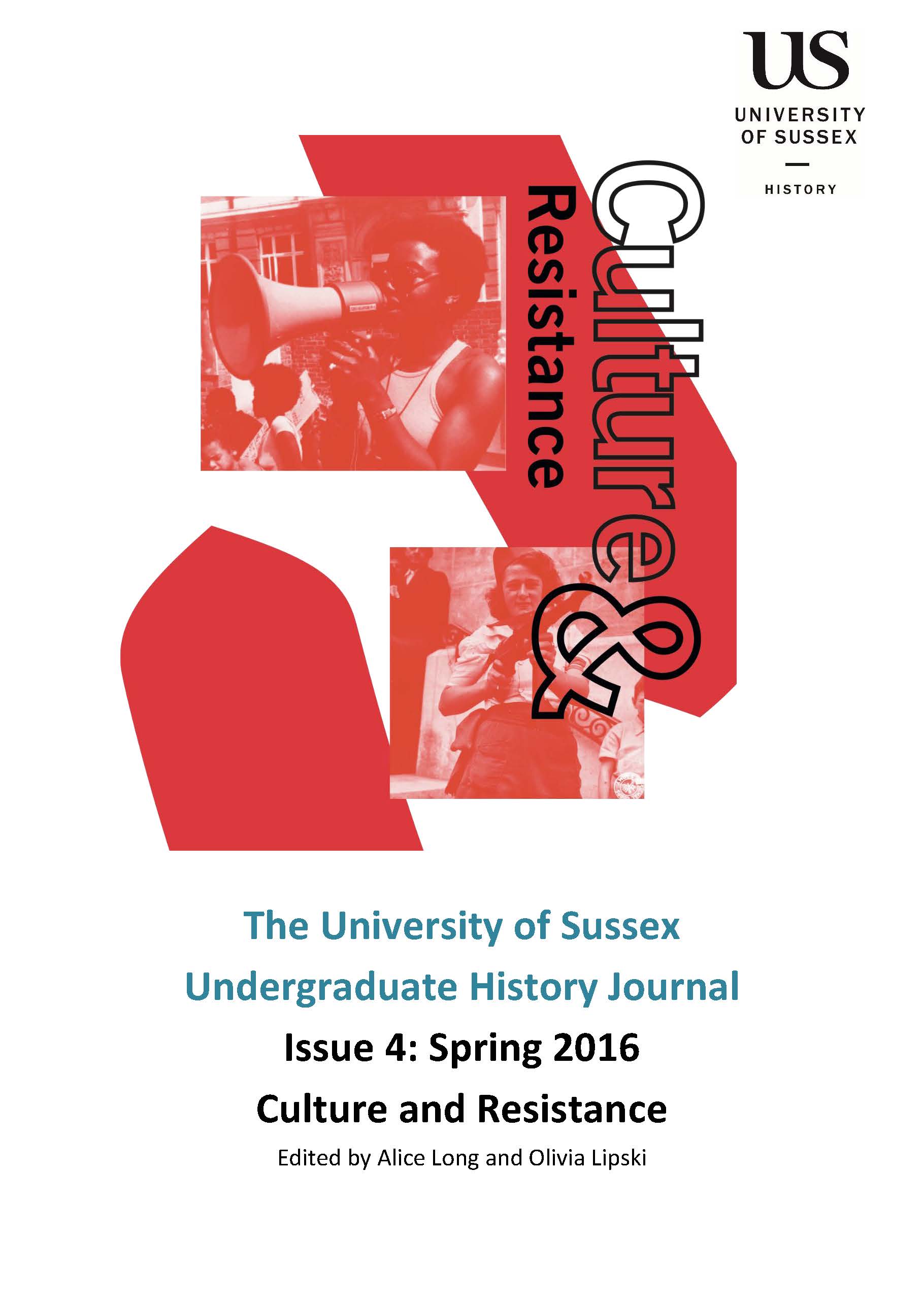
Spring 2016: Culture and Resistance
No. 4 (2016)In this issue we have chosen to focus on the topics of culture and resistance, aiming to explore cultures and their spaces whilst understanding the ways in which certain cultural groups have utilised and reshaped or challenged conventional notions of resistance. Whilst exploring what it means to resist in different cultures, we aim to showcase works which uncover and discuss areas of resistance which in the dominant historical narrative would be overlooked. The work in this journal endeavours to unveil a variety of different means of resistance through areas such as unionisation, solidarity, collaboration, music and fiction, providing a variety of unique perspectives across a vast time period.
Edited by Alice Long and Olivia Lipski.
Contents
Tania Shew, What can Fanny Kemble's journal tell us about female slave resistance in the 19th Century Antebellum South?
Kieran Campbell-Johnston, Service and labour: Domestic servants, unionisation and the ‘private sphere’ 1850-1914
Olivia Lipski, To what extent was the solidarity of the British Black women’s movement undermined by ethnic divisions?
Wesley Knowler, “Roots and Rave” as “The Enemy Within”: Sound-systems as sites of Resistance and Identification in 1980’s Britain
William Crona, The use and abuse of history in Midnight’s Children and Shame -
Spring 2020: History and Us
No. 5 (2020)This year’s journal, much like those gone before, seeks to showcase the creative and diverse history written by Sussex students; providing a platform capable of recognising the labours and talent of students whilst also offering the opportunity for debate and reflection on undergraduate work by sharing it with wider academia. Unlike previous journals however, we have chosen not to centre this issue around a core historical theme per se. Rather, in line with our aim to embody the journal’s original purpose, we have chosen to devote the focus of this issue to the reflection and exhibition of the inherently personal work created by Sussex history students. In choosing the title ‘History and Us’ we aim to emphasise the experience of a history student at Sussex as one that is individual and collective, comprised of independent study carried out as part of a wider experience shared by students, staff and academia exterior to the university.
Edited by Edward Hewes and John Butcher.
Contents
Billie Early, Should we do history for ourselves and society, rather than to meet epistemological, ideological and methodological standards?
Naomi Hodges, How did male sexuality change within the Arabic speaking Ottoman Empire during the period 1800-1920s?
Toby Henry Shields, Why were migrants from the West Indies unable to successfully assimilate into post-war British life?
John Butcher, Understanding witchcraft accusations in the Early Modern period
Works in progress by Lava Ali, Dan Thompson, and Tomas Heasman